
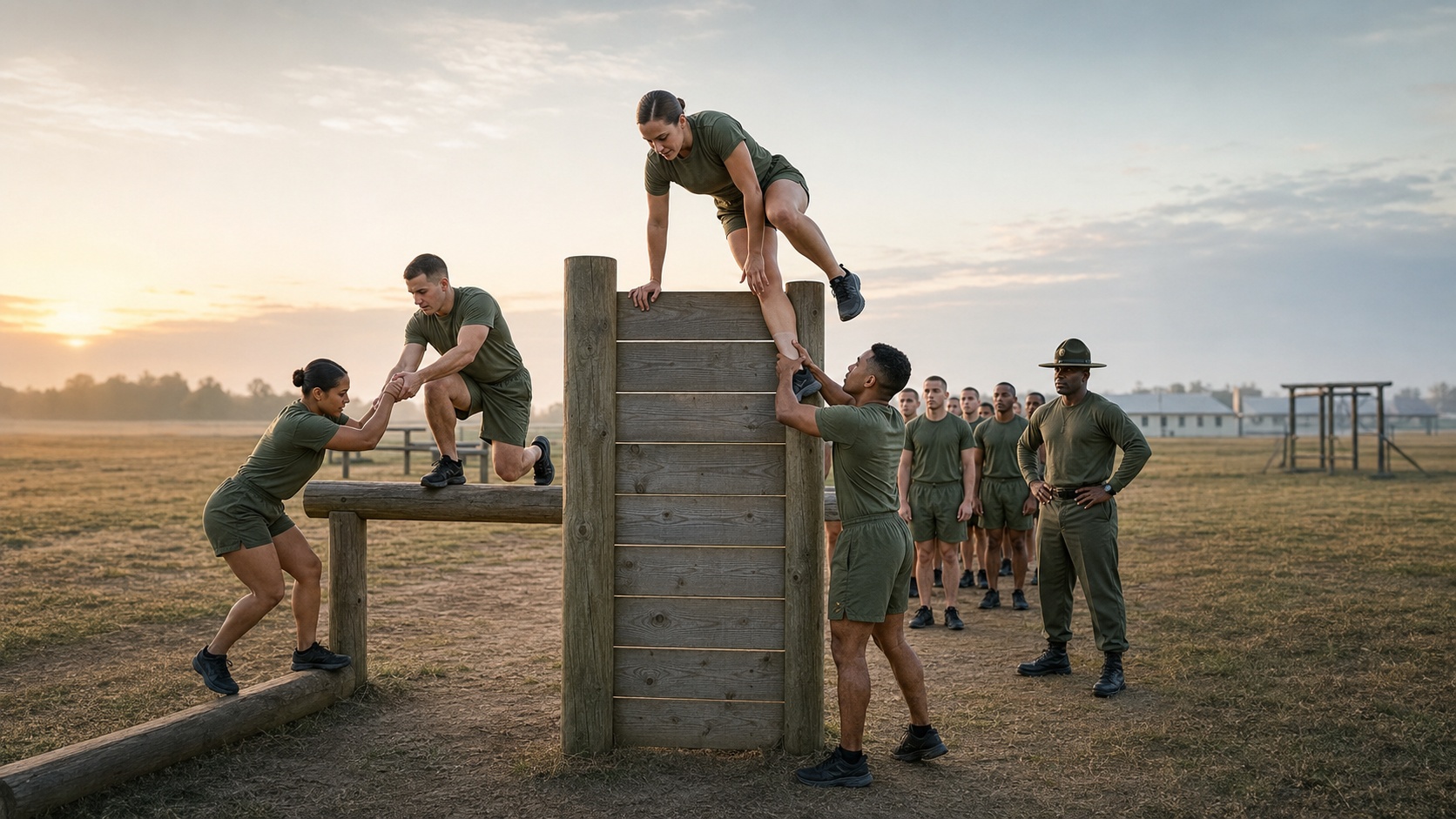
Military boot camp is the initial training program that turns a new enlisted recruit into a Soldier, Marine, Sailor, Airman, Guardian, or Coast Guardsman. Recruits learn military discipline, customs, physical fitness, teamwork, and the entry-level skills required by their service.
That basic definition is shared across the U.S. Armed Forces. The experience is not identical, though. The Army emphasizes soldiering and field skills. The Marine Corps builds every recruit around a common warfighting identity. The Navy and Coast Guard devote substantial time to maritime skills. The Air Force and Space Force combine military fundamentals with academic and technical preparation.
This guide covers all six U.S. military branches, including Space Force and Coast Guard. It explains how long boot camp lasts, where it happens, what recruits do, how they are paid, what happens if they fail, and what comes after graduation.
What Is Military Boot Camp?
Military boot camp is a controlled, full-time residential training program for newly enlisted service members. The formal name differs by branch:
| Service branch | Formal or commonly used name |
|---|---|
| Army | Basic Combat Training, or BCT |
| Marine Corps | Recruit Training |
| Navy | Recruit Training, commonly called boot camp |
| Air Force | Basic Military Training, or BMT |
| Space Force | Basic Military Training, or BMT |
| Coast Guard | Recruit Basic Training, commonly called boot camp |
The purpose is not to make a recruit an expert in a military occupation. Boot camp creates the common foundation first. Job-specific instruction usually comes afterward at Advanced Individual Training, the School of Infantry, an A school, technical training, or another service school.
Boot camp in this article means enlisted initial entry training. Officers follow different commissioning and officer-training pipelines. Army National Guard and Reserve recruits generally complete the same initial training required by their parent service, even though their later duty status differs.
Is It Bootcamp or Boot Camp?
For military training, write boot camp as two words. That is the standard dictionary form and the form used in military style guidance. Merriam-Webster defines boot camp as basic training for new military recruits and also recognizes its broader use for other intensive programs.
The single word bootcamp is common in product names, online searches, and marketing for accelerated civilian programs. You will see coding bootcamps, fitness bootcamps, business bootcamps, and cybersecurity bootcamps. In that setting, the word usually signals a short, concentrated crash course modeled loosely on the intensity of military training.
The distinction is a useful convention, not an absolute rule. A civilian program may still call itself a “boot camp” with two words, and some writers use “military bootcamp” informally. For an article about the armed forces, however, military boot camp is the clearest and most authoritative spelling.
Boot Camp vs. Basic Training: Is There a Difference?
In everyday conversation, boot camp and basic training usually refer to the same stage of an enlisted career. The difference is mostly one of service culture and official terminology.
“Basic training” is common when discussing the Army or the military in general. The Army’s formal term is Basic Combat Training. The Air Force and Space Force use Basic Military Training. The Navy frequently uses boot camp even though its training command is formally Recruit Training Command. The Marine Corps usually says recruit training, while families and the public often say Marine boot camp.
Do not confuse initial training with later specialty training. Completing boot camp means the recruit has met the service’s entry-level standards. It does not mean a new graduate is fully qualified for every task in an assigned job.
How Long Is Military Boot Camp?
Military boot camp lasts roughly 7.5 to 13 weeks, depending on the branch. Reception, processing, medical holds, holiday schedules, or being moved to a later training class can increase the total time away from home.
| Service branch | Approximate current length | Primary location or locations | Typical next step |
| Army | 10 weeks, plus reception | Fort Benning, Fort Jackson, Fort Leonard Wood, or Fort Sill | AIT or a combined OSUT pipeline |
| Marine Corps | About 13 weeks, including receiving | MCRD Parris Island or MCRD San Diego | School of Infantry pipeline |
| Navy | 9 weeks | Recruit Training Command Great Lakes, Illinois | A school or another follow-on assignment |
| Air Force | 7.5 weeks | Joint Base San Antonio-Lackland, Texas | Technical training |
| Space Force | 7.5 weeks | Joint Base San Antonio-Lackland, Texas | Space Force technical training |
| Coast Guard | 8 weeks | Training Center Cape May, New Jersey | First unit or rating training path |
These are planned course lengths, not guaranteed graduation dates. A recruit who needs remedial instruction, recovers from an injury, or repeats a required event may spend additional weeks in training.
What Happens at Military Boot Camp?
The first stage is usually reception or in-processing. Recruits complete administrative paperwork, medical and dental screening, drug testing, uniform issue, pay setup, and an initial fitness assessment. They are assigned to a training unit and meet the instructors who will control their schedule.
Training then progresses from basic compliance to practical performance. Common subjects include:
- Military rank, customs, courtesies, history, and core values
- The Uniform Code of Military Justice and standards of conduct
- Drill, formations, inspections, and proper uniform wear
- Physical fitness training and fitness evaluations
- First aid and emergency response
- Teamwork, communication, and leadership under stress
- Weapons safety and marksmanship where required
- Field, maritime, expeditionary, or defensive skills specific to the branch
- A final exercise or evaluation that combines earlier lessons
Recruits do not spend every hour exercising. A large share of boot camp is instruction, practice, cleaning, equipment accountability, movement between training sites, and waiting in formation. The pressure comes from having to perform ordinary tasks accurately, quickly, and as part of a team.
What Does a Typical Boot Camp Day Look Like?
Schedules vary by service, training week, weather, and planned events. A normal day may begin between 4:30 and 5:30 a.m. Recruits form up, complete physical training, eat breakfast, and move into drill, classroom, range, pool, field, or hands-on instruction. Evening periods may include equipment maintenance, barracks cleaning, study, personal hygiene, and preparation for the next day. Lights-out is commonly around 9:00 or 10:00 p.m.
The Army’s public Basic Training guide gives a representative schedule: wake at 4:30 a.m., formation at 5:00, physical training until 6:30, a full training day, evening barracks duties, and lights-out at 9:00. That is a useful example, not a promise that every branch or training company follows the same clock.
Do You Get Paid During Boot Camp?
Yes. Recruits are service members and receive military basic pay during boot camp. Basic pay is based on pay grade and time in service, and it is normally deposited electronically. Military OneSource states that monthly basic pay generally reaches the account in two payments each month.
The first deposit can take time to process. Net pay may also differ from the headline basic-pay figure because of taxes, elections, authorized deductions, or corrections made during in-processing. A recruit should set up a working bank account, arrange bills before shipping, and give trusted family members only the financial access that is actually necessary.
Housing, meals, uniforms, medical care, and required training equipment are handled through the service during boot camp. That does not mean every personal expense disappears. Recruits may still need money for approved personal items, and the exact accounting process differs by service.
Where Do Recruits Live, Eat, and Sleep?
Recruits live on the training installation in barracks, dormitories, or open squad bays. Privacy is limited. Sleeping areas, lockers, bathrooms, and common spaces must be maintained to a precise standard and may be inspected frequently.
Meals are normally served in a dining facility, galley, or chow hall. During field training, recruits may eat Meals, Ready-to-Eat or other field rations. Meals are scheduled and practical, not leisurely. Recruits are expected to hydrate, eat enough to support training, and follow instructions rather than pursue an independent diet plan.
Phone and internet access are restricted. Most services permit an arrival call and limited communication later, but frequency depends on the training unit and the recruit’s progress. Letters remain important. Families should follow the unit’s mailing and care-package rules because prohibited or oversized packages can create problems for the recruit.
What Can You Bring to Military Boot Camp?
Bring only what appears on the current packing list provided by the recruiter or service. The essentials usually include travel orders, required identification and banking information, approved clothing for travel, basic toiletries, and any specifically authorized documents.
Do not improvise from an old online packing list. Policies change, and each branch issues many items after arrival. Extra clothing, supplements, electronics, tobacco or nicotine products, alcohol, weapons, knives, pornography, and nonapproved medication may be prohibited, stored, or confiscated.
Prescription medication requires special care. Disclose it during the medical process and follow current recruiter and Military Entrance Processing Station instructions. Do not stop prescribed medication or bring undocumented medication based on advice from a forum or social media video.
What Are the Physical Requirements for Boot Camp?
Every branch evaluates fitness, but the events and scoring systems are not identical. Running, push-ups or related upper-body work, core endurance, and body-composition standards appear in several services. The Marine Corps also evaluates combat fitness. The Navy uses a Physical Readiness Test. Air Force and Space Force trainees complete BMT fitness assessments. Coast Guard recruits take entrance and later fitness evaluations.
The Army’s current test of record is the Army Fitness Test, or AFT. It replaced the Army Combat Fitness Test in 2025. This matters because older basic-training articles and videos still refer to the ACFT as current.
Minimum entry or graduation numbers can change by age, sex, occupation, program, or implementation date. Use the current official branch page and the standards supplied by a recruiter. Do not build a plan around a five-year-old chart.
Boot camp is also not the place to begin getting fit. Arrive able to run, perform sound calisthenics, move for extended periods, and recover from repeated training days. A balanced preparation plan should include aerobic work, gradual running volume, strength, mobility, sleep, and adequate food. Sudden high-mileage running or heavy unsupervised rucking can cause an injury before training even begins.
What Happens If You Fail Boot Camp?
One failed test does not automatically end a military career. Depending on the event and service, a recruit may receive remedial training, repeat the evaluation, or be moved to a later class. This is commonly called being recycled or set back. It delays graduation but gives the recruit another opportunity to meet the standard.
An injured or ill recruit may enter a medical hold or rehabilitation unit. The service may return the recruit to training after recovery, grant another disposition, or begin separation if the condition prevents continued service. Repeated academic, conduct, fitness, or performance failures can also lead to an entry-level separation.
A recruit cannot simply walk out or treat boot camp like a civilian course withdrawal. Enlistment creates a legal service obligation. Someone who wants to leave must notify the chain of command and go through the applicable counseling, medical, legal, and administrative process. Anyone facing that situation should use the official chain of command and qualified legal or medical resources, not barracks rumors.
Army Basic Training
Army boot camp is formally called Basic Combat Training. The current course lasts 10 weeks, with reception and in-processing occurring before the main training cycle. Depending on military occupational specialty and training assignment, recruits attend at Fort Benning, Georgia; Fort Jackson, South Carolina; Fort Leonard Wood, Missouri; or Fort Sill, Oklahoma. The Army determines the location based largely on the training pipeline, not personal preference.
The Army’s current BCT outline divides training into four phases. Yellow Phase introduces Army values, teamwork, discipline, and basic physical and tactical training. Red Phase adds weapons familiarization, lifesaving skills, combatives, and the Hammer field exercise. White Phase concentrates on rifle marksmanship, team skills, and the Anvil. Blue Phase develops more advanced weapons and maneuver skills before the Forge, a multiple-day field training exercise that tests fitness, Soldier skills, and survival.
What is the hardest week in Army boot camp? There is no universal answer, but Forge week is a strong candidate because it combines fatigue, field conditions, movement, teamwork, and cumulative testing. Other recruits find the first weeks hardest because they are adapting to the loss of privacy, rapid instructions, early mornings, and constant correction.
Army daily life is highly structured. Drill sergeants move recruits through physical training, classroom work, weapons ranges, obstacle courses, first aid, land navigation, field training, meals, cleaning, and equipment accountability. Recruits live in barracks and typically eat in a dining facility, with field meals used during exercises. After BCT, most Soldiers proceed to Advanced Individual Training for their job. Some specialties use One Station Unit Training, which combines the basic and job-training phases in one longer pipeline.
Marine Corps Boot Camp
Marine recruit training is approximately 13 weeks when receiving is included. Recruits train at Marine Corps Recruit Depot Parris Island in South Carolina or Marine Corps Recruit Depot San Diego in California. Assignment has traditionally been influenced by geography, although current orders and service needs control where an individual reports.
The Marine Corps recruit-training program is designed around a common premise: every Marine receives a warfighting foundation, regardless of later military occupational specialty. Recruits complete demanding physical conditioning, close-order drill, Marine Corps history and customs, first aid, water survival, martial arts, confidence events, rifle instruction, field skills, inspections, and academic testing. The pace is deliberate. Instructors are developing instant response, attention to detail, endurance, and commitment to the team.
The Crucible is the best-known capstone. It is a continuous field event that combines limited sleep, movement, obstacles, problem-solving, and tasks drawn from earlier training. This is one reason Marine boot camp is often described as the hardest of the services. That label is subjective, but the roughly 13-week length, physical standards, rifle emphasis, and Crucible make the claim understandable.
Hair and grooming rules are applied according to current Marine standards. Recruits should expect a standardized, highly controlled appearance, but popular claims that every recruit receives the identical haircut are too broad. After graduation, Marines enter the School of Infantry training pipeline. Infantry Marines continue through infantry training, while non-infantry Marines complete Marine Combat Training before moving to occupational schooling.
Navy Boot Camp
Navy boot camp takes place at Recruit Training Command Great Lakes, Illinois, the Navy’s only enlisted recruit-training site. The Navy’s current boot camp page lists the program as 9 weeks. Older articles may say 7, 8, or 10 weeks, which is why current service information should control.
The first stage is processing. Recruits receive medical, dental, drug, and fitness screening, uniforms, administrative setup, and a division assignment. Recruit Division Commanders then train the division in Navy customs, military discipline, drill, physical readiness, watchstanding, rank structure, basic seamanship, water survival, damage control, firefighting, weapons handling, force protection, and emergency response.
The Navy says the first two weeks are often the most challenging because recruits are adjusting from civilian life to a tightly managed team environment. The culminating Battle Stations evaluation tests how the division applies what it learned under pressure. Passing the capstone and all other requirements leads to graduation as a Sailor.
Recruits live in ship-named barracks facilities and use Navy terminology as part of their immersion. They do not spend nine weeks learning a specific rating in depth. After boot camp, most Sailors report to an A school or another training assignment for rating-specific skills. The location and length depend on the job in the enlistment contract.
Air Force Basic Training
Air Force boot camp is officially Basic Military Training. It runs for 7.5 weeks at Joint Base San Antonio-Lackland in Texas. Every enlisted Airman begins with this common course before moving into an Air Force specialty.
During Air Force BMT, Military Training Instructors lead trainees through physical fitness, drill, dormitory standards, inspections, rank and reporting procedures, Air Force history and core values, weapons familiarization, basic defense, combat lifesaving, teamwork, and field-oriented skills. Classroom performance matters. So does the ability to follow detailed procedures when tired or under time pressure.
Week 0 centers on arrival, assignment, issue, screening, and the shock of adjustment. Training then builds toward fitness and academic evaluations, field exercises, final inspections, and graduation. Some trainees find the early weeks hardest because nearly every routine is unfamiliar. Others struggle more when cumulative evaluations arrive later.
Air Force recruits live in dormitories with their flights and follow a tightly controlled schedule. Approved phone contact and personal time are limited. After BMT, graduates travel to technical training. Air Force technical school can last from several weeks to many months, depending on the career field.
Space Force Basic Training
The Space Force is a separate armed service organized under the Department of the Air Force. Enlisted Guardians attend 7.5 weeks of Basic Military Training at Joint Base San Antonio-Lackland alongside Air Force trainees. The Space Force does not operate a separate boot camp installation.
According to the official Space Force training page, Guardians complete the Air Force BMT foundation plus 21 hours of Space Force-specific instruction. That curriculum includes Space Force structure, military doctrine, senior-leader briefings, and emotional intelligence. Physical training, testing, drill, discipline, inspections, and basic military subjects still apply. A technical or space-focused career does not eliminate the requirement to meet military standards.
How hard is Space Force boot camp? The physical and daily-control environment is based on Air Force BMT, while the additional service curriculum raises the academic load. The difficulty often comes from handling both at once. After graduation, Guardians move to technical training for their assigned specialty. The school and timeline vary by career field.
Coast Guard Basic Training
Coast Guard boot camp is an 8-week recruit basic training course at Training Center Cape May, New Jersey. It is the Coast Guard’s only enlisted basic-training location. The Coast Guard is one of the six U.S. Armed Forces, even though its peacetime department and mission mix differ from the services most people picture when they hear “military.”
During the Coast Guard’s official basic training program, company commanders teach discipline, teamwork, military justice, ethics, Coast Guard history, physical fitness, and service standards. Practical instruction includes firearms, basic seamanship, firefighting, damage control, and first aid. Recruits take an entrance fitness test during the first week and must meet the required performance and academic standards to graduate.
The course is short compared with Army or Marine training, but the compressed schedule and broad maritime curriculum make it demanding. Recruits must absorb classroom material, demonstrate water and seamanship competence, maintain barracks and uniform standards, and perform under close supervision. The Coast Guard also confirms that recruits are paid by automatic deposit during training.
After Cape May, some graduates report directly to an operational unit as non-rated members and gain experience before rating school. Others follow a training path established by their enlistment program or assignment. The correct next step depends on the contract, rating process, and current Coast Guard personnel needs.
Which Military Boot Camp Is the Hardest?
There is no official, standardized ranking of the hardest military boot camp. Each service builds training around a different mission, and personal strengths change the answer.
Marine recruit training is the longest of the six programs listed here and includes the Crucible, so it is most often given the “hardest boot camp” label. Army BCT places heavier emphasis on sustained field and Soldier skills. Navy and Coast Guard recruits must master water, damage-control, and maritime subjects. Air Force and Space Force trainees face close procedural control, fitness requirements, inspections, and significant academic content.
A strong distance runner may still struggle with swimming, marksmanship, inspections, or rapid memorization. A technically gifted recruit may struggle with sleep disruption and team pressure. The relevant question is not which branch wins an internet argument. It is whether a recruit is prepared for the exact service and training pipeline chosen.
How to Prepare for Military Boot Camp
Start with the recruiter and the branch’s current official preparation material. Recruiters can confirm the ship date, fitness expectations, packing list, required documents, medication rules, and any changes that have not reached older web pages.
Use the weeks before shipping to build reliable habits:
- Train consistently. Develop an aerobic base, run gradually, practice sound calisthenics, and strengthen the legs, core, back, and shoulders.
- Avoid last-minute hero workouts. A stress fracture or tendon injury can delay entry before the first training day.
- Practice early mornings. A regular sleep schedule makes the first weeks less disorienting.
- Learn the basics. Study ranks, phonetic alphabet, service values, reporting language, and any material the recruiter provides.
- Handle personal administration. Arrange bills, banking, emergency contacts, dependent needs, and important documents before leaving.
- Break equipment dependencies. Expect little access to a phone, entertainment, caffeine rituals, or preferred foods.
- Take foot care seriously. Use properly fitted running shoes before shipping, trim nails correctly, and address persistent pain early.
- Arrive teachable. Listen to the full instruction, move with purpose, help the team, and do not argue from something seen online.
Fitness is only one part of readiness. A recruit who can recover, accept correction, manage frustration, and keep track of equipment has a major advantage.
Common Questions About Military Boot Camp
Do They Shave Your Head at Boot Camp?
Hair is cut or controlled to meet the branch’s recruit-training and grooming standards. The exact rule is not identical for every service or every recruit. Follow the current service guidance and expect limited personal styling options.
Can Family Attend Boot Camp Graduation?
Most training commands hold a graduation ceremony and often permit approved guests. Access rules, identification requirements, schedules, and liberty policies can change. Families should use the official training-command page and information sent by the recruit’s unit before buying nonrefundable travel.
Can You Use Your Phone During Boot Camp?
Access is limited and controlled. An arrival call is common, and some units allow later calls at designated times. A phone should never be treated as guaranteed weekly access. Training performance, schedule, service rules, and emergencies can all affect communication.
What Does Boot Camp Test Besides Fitness?
It tests judgment, discipline, memory, attention to detail, teamwork, emotional control, academic knowledge, and service-specific practical skills. A recruit can be physically strong and still fail an inspection, written test, water event, marksmanship requirement, or conduct standard.
What Happens After Military Boot Camp?
Graduates continue to job or follow-on training unless their program sends them directly to a unit. Army Soldiers usually attend AIT or continue OSUT. Marines enter the School of Infantry pipeline. Sailors commonly attend A school. Airmen and Guardians go to technical training. Coast Guard graduates may report to a unit or follow the rating-training route established for them.
Boot camp builds the baseline. Operational competence comes from later schools, supervised practice, unit training, and experience.
Official Sources and Further Reading
- U.S. Armed Forces overview
- Army Basic Combat Training
- Marine Corps Recruit Training
- Navy Boot Camp
- Air Force Basic Military Training
- Space Force Training
- Coast Guard Basic Training
- Military OneSource Basic Training Resources
- Military OneSource Military Pay Guide
- Current Army Fitness Test Information
- Merriam-Webster: Boot Camp
Your Final Pre-Ship Check
Military boot camp is a recruit’s first full immersion in military life. It is intentionally stressful, but the stress has a purpose: teach standards, build dependable habits, and prove that individuals can function as a team.
Use branch-specific information, because there is no single schedule, fitness test, or training location for the entire military. Confirm every important detail with the recruiter and current service guidance. Then arrive fit, organized, rested, and ready to learn.
The goal is not to know every answer before stepping off the bus. The goal is to show up prepared to meet the standard and keep improving until graduation.