
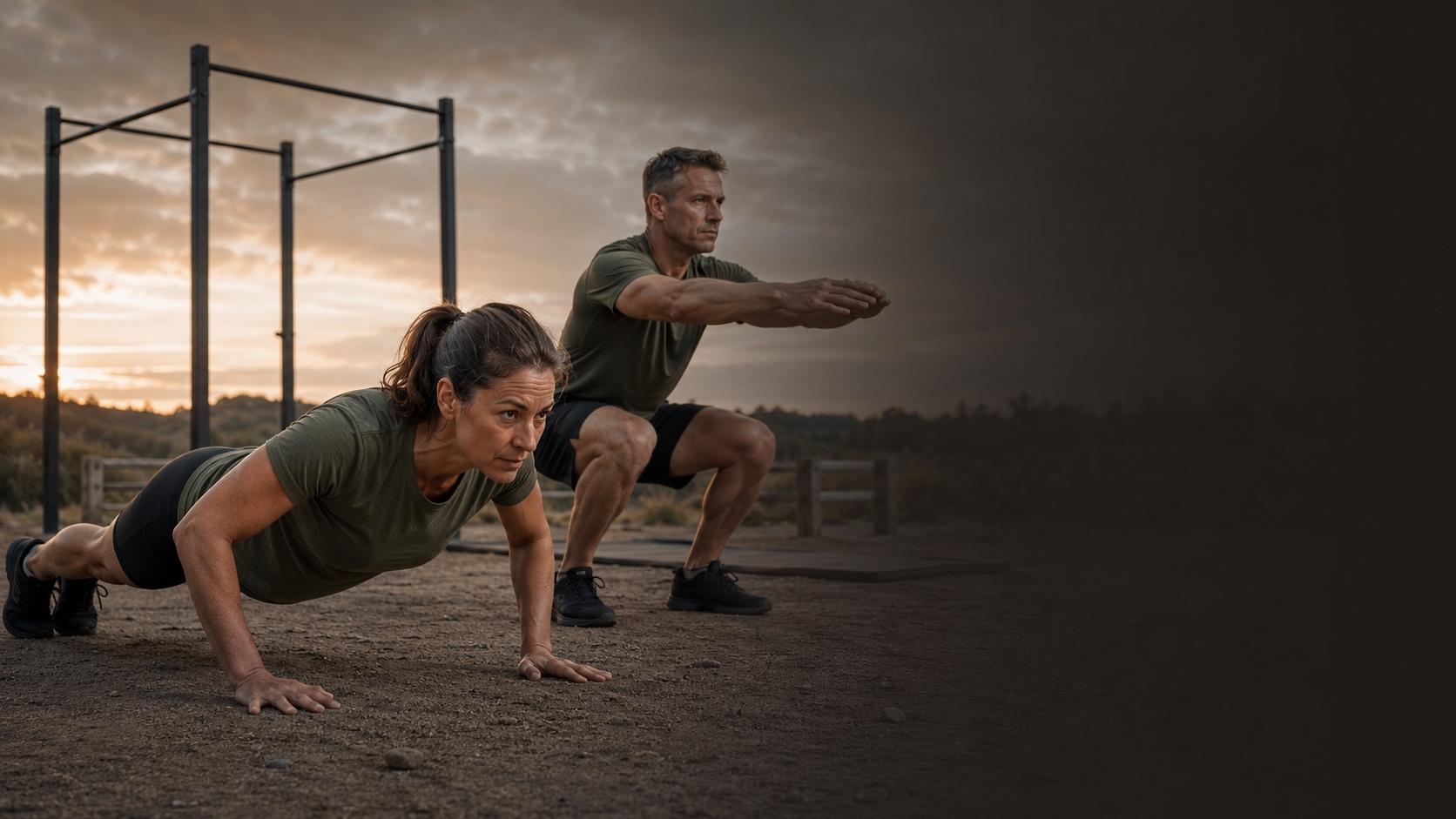
Military calisthenics is a style of physical training that uses bodyweight exercises, short rest periods, and repeatable drills to build strength endurance, work capacity, coordination, and discipline. Push-ups, squats, lunges, pull-ups, planks, running drills, and burpees are common examples.
Despite the name, military calisthenics is not one official workout followed by every armed service. It is a broad fitness label based on movements long used in military physical training. Modern military fitness is wider than calisthenics alone. It may also include sprinting, distance running, rucking, loaded carries, barbell work, kettlebells, sandbags, mobility, and recovery.
That distinction matters. A 15-minute bodyweight circuit can improve fitness, but it does not reproduce the full physical demands of military training or prepare someone for every military fitness test.
What Is the Difference Between Calisthenics and Military Calisthenics?
Calisthenics is any form of training that primarily uses body weight as resistance. The category ranges from basic air squats to advanced skills such as handstand push-ups, muscle-ups, and front levers.
Military calisthenics emphasizes practical output instead of gymnastic skill. The main targets are usually:
- Repeating basic movements with proper form
- Building upper-body, lower-body, and core endurance
- Moving efficiently while tired
- Training several muscle groups in one session
- Performing workouts with little equipment
- Developing general conditioning that can support running, marching, climbing, carrying, and field tasks
Military-style sessions also tend to use a circuit, timed interval, drill, or formation format. A recreational calisthenics athlete might spend a session practicing one difficult skill. A military calisthenics workout is more likely to combine push-ups, squats, lunges, pull-ups, core work, and cardio with controlled rest.
The U.S. Army defines physical readiness as the ability to meet the demands of a duty or combat position, complete the mission, and return healthy. Its current physical domain covers power, maximum strength, upper-body endurance, anaerobic capacity, core endurance, and aerobic capacity. In other words, bodyweight calisthenics is useful, but it is only one part of complete military readiness.
What Is a Military Calisthenics Exercise?
A military calisthenics exercise is usually a simple bodyweight movement that can be taught to a group, scaled to different fitness levels, and repeated without complicated equipment.
Five Foundational Military Calisthenics Exercises
- Push-up: Trains the chest, shoulders, triceps, and the ability to hold a rigid trunk.
- Air squat: Develops the thighs, hips, and basic squat movement pattern.
- Pull-up or body row: Builds the back, biceps, forearms, and grip strength. A pull-up bar or sturdy row setup is required.
- Reverse lunge: Trains each leg independently and challenges balance with less forward knee travel than many people use during a forward lunge.
- Plank: Builds core stability by teaching the trunk to resist extension. Sit-ups and crunches place more direct emphasis on the rectus abdominis, but a strong core also requires the hips, back, obliques, and deeper trunk muscles.
Other common bodyweight movements include mountain climbers, step-ups, crawling drills, squat thrusts, jumping jacks, dips, leg raises, shuttle runs, and burpees. A program may add resistance bands, a weighted vest, a sandbag, or a ruck once the trainee has earned that progression.
What Is a Military Calisthenics Workout?
A sound military calisthenics workout has four parts: preparation, strength-endurance work, conditioning, and recovery. It should not begin with an all-out set of burpees while the joints and muscles are cold.
1. Preparation
Spend five to ten minutes raising body temperature and rehearsing the movements in the workout. March or jog lightly. Then use controlled squats, hip hinges, arm circles, lunges, and easy push-up variations.
2. Strength-Endurance Circuit
Perform several bodyweight exercises in sequence. The goal is to complete quality repetitions while fatigue gradually rises. Stop a set when form breaks down. Training through ugly repetitions teaches poor movement and adds needless joint stress.
3. Conditioning
Short runs, step-ups, jumping jacks, shuttle sprints, or fast marching can raise the cardiovascular demand. Beginners and people managing joint issues can use brisk walking or low-impact step-ups instead of jumping.
4. Cooldown and Recovery
Walk until breathing settles. Follow with relaxed mobility for the areas trained. Recovery also includes sleep, food, hydration, and enough time before the next hard session.
How to Build a Military Calisthenics Workout Plan
A useful military workout plan does not string together popular exercises at random. It balances pushing, pulling, knee-dominant leg work, hip-dominant movement, core training, and conditioning. It also states how the workload will progress.
Many military workouts are hybrid sessions. Calisthenics may be paired with running, rucking, lifting, carries, or obstacle practice. A general home routine does not need every element, but it should train the overall body instead of chasing a large push-up count while ignoring the back and legs.
If you save a routine as a military calisthenics workout PDF, include the exercise variation, target reps, rounds, rest period, and progression rule. A printable list without those details is a collection of exercises, not a complete training plan.
Sample 20-Minute Military Calisthenics Workout
This full-body routine is for a generally healthy adult who already knows the basic movements. Complete three rounds. Rest for 60 to 120 seconds between rounds, or longer if proper form requires it.
| Exercise | Target |
|---|---|
| Push-ups | 8 to 15 reps |
| Air squats | 15 to 20 reps |
| Pull-ups or body rows | 5 to 10 reps |
| Reverse lunges | 8 reps per side |
| Plank | 20 to 45 seconds |
| Burpees or low-impact squat thrusts | 5 to 10 reps |
| Fast march, step-ups, or run | 60 seconds |
Warm up before the first round. Do not treat the listed maximums as mandatory. Eight clean push-ups provide a better training signal than 15 repetitions performed with a sagging back and shortened range of motion.
To make the routine harder, first add repetitions within the listed ranges. Next, add a round or choose a more challenging exercise variation. Reduce rest only after you can preserve technique. This is progressive overload applied to bodyweight training.
What Is Military Calisthenics for Beginners?
Beginner military calisthenics is a scaled training program that builds movement quality and repeatable strength before high-rep work. It should feel structured, not punishing.
Start with two or three nonconsecutive sessions per week. Complete two rounds of the following circuit:
| Beginner Exercise | Target |
| Chair squat or partial squat | 8 to 12 reps |
| Wall or incline push-up | 6 to 10 reps |
| Supported reverse lunge or split squat | 5 to 8 reps per side |
| Resistance-band row or assisted pull-up | 8 to 12 reps |
| Glute bridge | 10 to 15 reps |
| Dead bug | 6 to 10 reps per side |
| Brisk march | 30 to 60 seconds |
Rest as needed between exercises and for 60 to 120 seconds between rounds. After one or two weeks, add repetitions gradually. When you can reach the top of a range with proper form in both rounds, progress one element. You might lower the push-up incline, add a third round, or move from a chair squat to an unrestricted squat.
Avoid changing everything at once. A beginner who adds reps, rounds, harder variations, sprints, and a weighted vest in the same week has no reliable way to judge recovery.
What Is Military Calisthenics for Women?
Military calisthenics for women uses the same core training principles as a program for men. Women do not need a separate collection of supposedly feminine exercises. Squats, push-ups, rows, pull-ups, lunges, carries, and core work are useful across sexes.
The correct starting variation depends on the individual. On average, many untrained women will need more initial scaling for upper-body exercises such as push-ups and pull-ups. That is a starting-point issue, not a reason to remove upper-body training. Incline push-ups, resistance-band rows, assisted pull-ups, and controlled negatives create a clear path toward the standard versions.
Pregnancy, recent childbirth, pelvic-floor symptoms, or abdominal separation require more specific guidance than a general internet workout can provide. The Army itself uses a separate Pregnancy and Postpartum Performance Training program rather than expecting every woman to continue ordinary unit training without modification.
Military Calisthenics Workout for Women
This balanced routine trains the entire body without assuming that every woman has the same ability or goal. Complete two or three rounds.
| Exercise | Target |
| Incline or floor push-up | 6 to 12 reps |
| Squat to chair or air squat | 10 to 15 reps |
| Band row or body row | 8 to 12 reps |
| Reverse lunge | 6 to 10 reps per side |
| Glute bridge | 12 to 15 reps |
| Dead bug or side plank from knees | 6 to 10 reps per side or 15 to 30 seconds |
| Step-ups or fast march | 45 to 60 seconds |
Rest for 60 to 120 seconds between rounds. If the routine feels easy with clean form, increase one variable at a time. Add reps, use a harder movement, or complete another round.
What Is Military Calisthenics for Women Over 40?
For women over 40, military calisthenics should preserve the useful parts of military-style training while controlling impact and fatigue. Age 40 is not a cutoff point. A trained 45-year-old may tolerate far more work than a sedentary 25-year-old. Training history, sleep, current injuries, menopause-related changes, and recovery capacity matter more than the birthday alone.
A sensible plan includes:
- Two or three strength-focused sessions each week
- At least one pulling exercise for every workout that includes push-ups
- Squats, lunges, hip hinges, bridges, and step-ups for the lower body
- Progressive loading through harder variations, bands, a vest, or external resistance
- Low-impact cardio on recovery days
- Jumping and high-rep burpees only when the knees, feet, and pelvic floor tolerate them well
Do not confuse joint pain with productive effort. Muscle fatigue and increased breathing are expected. Sharp pain, chest pain, dizziness, or pain that changes movement mechanics is a reason to stop and assess the problem.
What Is Military Calisthenics for Women Over 50?
Military calisthenics for women over 50 is bodyweight strength and conditioning adjusted to current ability, joint tolerance, and recovery. Resistance training becomes especially valuable with age because it supports muscle strength, physical function, and the ability to perform daily tasks.
The federal Physical Activity Guidelines recommend muscle-strengthening work for all major muscle groups on at least two days per week. Older adults should also include aerobic and balance activities, with effort scaled to their fitness and health conditions.
A strong starting session might use chair squats, wall or incline push-ups, band rows, supported split squats, calf raises, glute bridges, carries, and single-leg balance near a stable support. Perform one to three sets of six to 12 controlled reps. Leave two or three good repetitions in reserve instead of taking every set to failure.
Women over 50 do not need to avoid intensity forever. They need an entry point they can recover from and a progression they can measure. Once a movement is easy, add range of motion, repetitions, resistance, or a more demanding variation.
What Is Military Calisthenics for Men?
Military calisthenics for men follows the same movement and progression principles. A common mistake is using high repetition counts as the only measure of progress. Doing 100 partial push-ups is not automatically better than completing several controlled sets through an appropriate range of motion.
Men seeking strength and muscle mass should eventually progress beyond basic air squats and easy push-ups. Harder variations, pull-ups, dips, unilateral leg work, a weighted vest, and external resistance can keep the stimulus challenging. Barbell deadlifts, loaded carries, or kettlebells may also fill gaps that bodyweight circuits do not address efficiently.
Calisthenics can build an athletic upper body and strong relative strength. It is less efficient for maximizing lower-body strength once ordinary squats and lunges become easy.
What Is Military Calisthenics for Men Over 40?
For men over 40, the best program is not an attempt to recreate the first day of boot camp after years away from training. Start from current capacity.
Use a thorough warm-up. Balance pushing with rows or pull-ups. Train the posterior chain with hip hinges, bridges, hamstring variations, carries, or weights. Keep one or two easier days between hard full-body sessions until recovery is predictable.
High-impact drills are optional. Replace repeated jump squats or burpees with step-ups, fast marching, sled work, cycling, or short hill walks when joints do not tolerate impact. The workout should still be demanding, but fatigue should not control technique.
What Is Military Calisthenics and Does It Work?
Yes, military calisthenics works when the program matches the goal and becomes progressively harder. Bodyweight training can improve muscular endurance, relative strength, movement control, and cardiovascular conditioning. One small controlled study of 23 young men found that progressive push-up training improved upper-body strength comparably to a bench-press program over four weeks. The narrow sample and short study period mean that finding should not be treated as proof that every calisthenics program equals weight training for every goal.
It works especially well for:
- Building a fitness base with little equipment
- Improving push-ups, pull-ups, squats, and similar fitness-test movements
- Training several major muscle groups in limited time
- Developing strength endurance and general work capacity
- Maintaining a routine while traveling or training at home
It has limits.
- Maximum strength: Heavy resistance is usually more efficient for developing maximal force.
- Lower-body progression: Air squats eventually become too easy for many trainees.
- Pulling strength: Effective rows and pull-ups require a bar, rings, bands, or another secure setup.
- Military preparation: Calisthenics alone does not prepare the feet, legs, and back for running, rucking, or carrying equipment.
- Muscle gain: Bodyweight exercise can build muscle, but the movement must remain challenging and total training, protein intake, calories, sleep, and recovery still matter.
Can Military Calisthenics Get You Ripped?
It can help build muscle and expend energy, but no routine guarantees a ripped appearance. Visible definition depends heavily on body-fat level, nutrition, training history, and genetics. Claims that a short daily circuit will automatically burn fat from a specific area are marketing, not physiology.
Does 15 Minutes of Military Calisthenics Work?
Fifteen focused minutes can improve fitness, particularly for a beginner or someone who was previously inactive. It can also maintain a useful habit on a busy day. Results depend on exercise selection, effort, weekly frequency, and progression.
Fifteen minutes is not magic. It may be too little for a complete strength and conditioning program, especially after the trainee becomes experienced. Treat it as a compact session, not proof that recovery, nutrition, aerobic work, and progressive strength training no longer matter.
What Are Military Calisthenics?
The plural phrase refers to the bodyweight drills used within military-style fitness, such as push-ups, squats, lunges, pull-ups, planks, crawling movements, and squat thrusts. There is no single universal list shared by every military branch.
How Often Should You Do Military Calisthenics?
Most beginners can start with two or three full-body sessions per week on nonconsecutive days. More experienced trainees can train more often by alternating movement patterns, intensity, and conditioning.
Daily movement is healthy for most people. Daily all-out push-ups, pull-ups, burpees, and sit-ups are not necessary. Muscles, tendons, and joints need time to adapt. If repetition quality falls from session to session, soreness never resolves, sleep worsens, or performance declines, reduce the volume or intensity.
Federal guidelines recommend that adults perform muscle-strengthening activity for all major muscle groups on at least two days each week. They also recommend 150 to 300 minutes of moderate aerobic activity, or 75 to 150 minutes of vigorous aerobic activity, per week. A military-style program can contribute to those totals, but it should be planned rather than improvised.
Do You Need Equipment?
You can start with no equipment, but a pull-up bar or resistance bands make the program more balanced. They provide pulling work that is difficult to reproduce on an empty floor.
You do not need a complete garage gym or branded equipment from REP Fitness or any other company. If you use a doorway bar, bench, chair, suspension trainer, or improvised row station, make sure it is stable and rated for the task. Do not trade safety for the appearance of tactical training.
How to Progress Without Turning Every Workout Into a Test
Track each exercise, variation, number of sets, reps, and rest time. Then progress one variable:
- Add one or two reps while maintaining form.
- Add a set after the current workload is comfortable.
- Increase range of motion.
- Use a harder variation, such as moving from incline push-ups to floor push-ups.
- Add light external resistance.
- Reduce rest slightly when conditioning is the goal.
Do not test the maximum number of repetitions in every workout. Fitness tests measure performance. Training should build it.
When Military Calisthenics Is Not Enough
A complete strength and conditioning plan may need more than bodyweight circuits. Anyone preparing for military service, a specific fitness test, or Special Forces Assessment and Selection should train for the actual standards and job demands. That may include running, rucking, sprinting, swimming, obstacle work, heavy carries, grip training, and lifting.
Rucking deserves special caution. It is not simply walking with the heaviest bag available. Load, footwear, terrain, pace, and weekly distance should increase gradually. A person who has built push-up endurance has not automatically conditioned the feet and lower legs for loaded miles.
Safety Before Intensity
Speak with a qualified health professional before beginning a demanding program if you have a cardiovascular condition, uncontrolled blood pressure, a recent surgery, significant joint pain, pregnancy or postpartum concerns, or symptoms triggered by exercise.
Stop training and seek medical guidance for chest pain, fainting, severe shortness of breath that is out of proportion to the effort, or sudden neurological symptoms. General fitness advice cannot diagnose an injury or replace individualized medical care.
Sources and Further Reading
- U.S. Army Holistic Health and Fitness, Physical Domain
- U.S. Army Field Manual 7-22, Physical Readiness Training
- Physical Activity Guidelines for Americans, Second Edition
- Progressive Push-Up Training and Muscle Strength
- Resistance Training for Older Adults: Position Statement
- U.S. Army Pregnancy and Postpartum Performance Training
Final Action Review
Military calisthenics is practical bodyweight strength and conditioning organized around simple movements, repeatable effort, and minimal equipment. It works, but the military label does not make a random high-rep circuit effective.
Start with movements you can control. Train the entire body. Progress one variable at a time. Add running, rucking, weights, or other job-specific work only when those tools serve the actual goal. The best military calisthenics plan is not the one that leaves you on the floor after day one. It is the one that makes you measurably more capable over the next several months.