
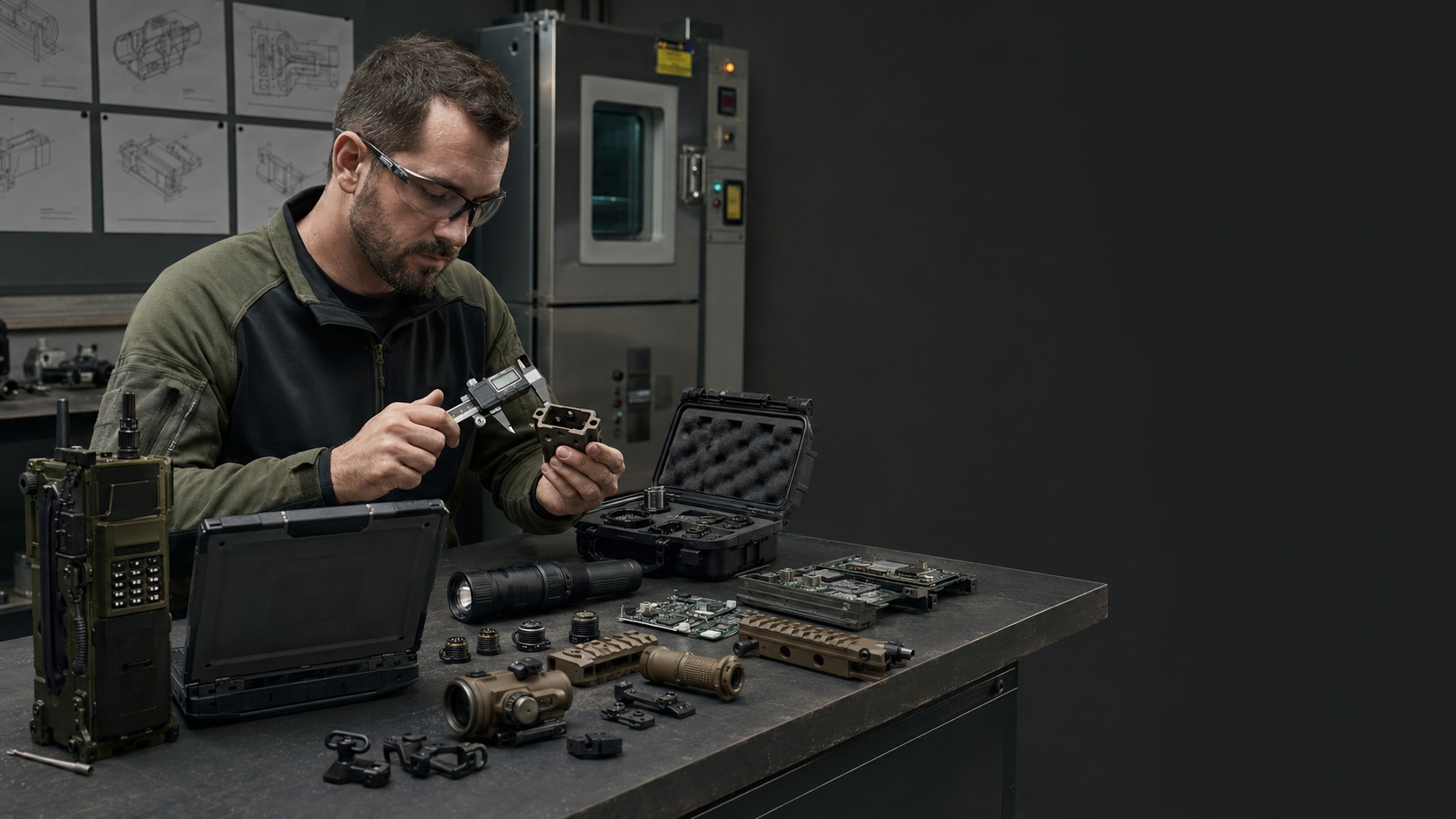
MILSPEC is shorthand for military specification. In its strict sense, MIL-SPEC refers to a controlled technical document that defines requirements for a product, material, component, process, or service used in defense acquisition.
The label is also used loosely in the civilian world. Manufacturers place “mil-spec” on tactical gear, electronics, vehicle parts, packaging, and AR-15 components. Sometimes the claim identifies real MIL-SPEC components or standards set by DoD. Sometimes it only suggests ruggedness or compatibility.
That difference matters. A product must meet the cited requirements, not merely resemble service equipment. A credible MIL-SPEC claim should answer three questions: Which document applies? Which revision was used? What evidence shows that the product meets it?
What Does MILSPEC Mean?
MILSPEC means military specification. You may see the term written as MIL-SPEC, milspec, mil spec, or mil-spec. The formal document designation normally uses a hyphenated prefix, while “milspec” is common in searches and informal writing.
A military specification is not one universal quality level or set of standards. It is a particular group of technical requirements created for a defined acquisition need. Depending on the document, those requirements may address:
- Materials and chemical composition
- Dimensions and tolerances
- Performance under stated conditions
- Interfaces and compatibility
- Manufacturing or finishing processes
- Inspection and test methods
- Packaging, marking, storage, and transport
- Reliability, safety, and quality control
- Qualification or acceptance criteria
The relevant document may apply to something as small as a fastener or electronic component. It may also support a complex aerospace, vehicle, communications, or weapon system. Adherence must be judged against the stated scope.
The word mil by itself can mean several things in technical and tactical contexts. It may refer to the military, a unit equal to one-thousandth of an inch, or an angular unit used in optics and related to the milliradian. A MILSPEC document should therefore be identified by its complete document number, not by the word “mil” alone.
What Is the Difference Between MIL-SPEC and MIL-STD?
MIL-SPEC and MIL-STD are related, but they are not interchangeable.
| Term | Basic purpose | Common designation |
|---|---|---|
| MIL-SPEC | Describes requirements for a product or material being acquired | MIL-PRF or MIL-DTL |
| MIL-STD | Establishes uniform engineering or technical practices, interfaces, design criteria, processes, or test methods | MIL-STD |
| MIL-HDBK | Provides technical guidance and reference information | MIL-HDBK |
| Commercial Item Description | Describes an available commercial product for government acquisition | A-A |
| Non-government standard | Provides an industry consensus standard that an acquisition may adopt | ASTM, SAE, ANSI, ISO, and others |
The Defense Standardization Program identifies two main forms of defense specification. A MIL-PRF performance specification states the required results and the criteria used to verify them without prescribing every method for achieving those results. A MIL-DTL detail specification can define materials, design features, dimensions, fabrication, or other detailed requirements.
A military standard, or MIL-STD, deals with standardized practices and methods. The phrase United States Military Standard generally refers to this document family. The United States Department of Defense recognizes five broad types: standard practices, interface standards, design criteria standards, test method standards, and manufacturing process standards.
You may also encounter the unhyphenated search form mil std. It refers to the same general family of military standards, but the complete identifier is what determines the actual requirements.
How Does a MIL-SPEC Requirement Work?
A genuine requirement has more structure than a marketing phrase.
A Document Establishes the Scope
Every specification or standard has an identifier, title, scope, date, status, and revision history. The scope explains what the document covers and, just as important, what it does not cover.
For example, a specification for a coating does not certify the entire product receiving that coating. A test-method standard does not necessarily define a universal product design. The claim must stay within the document’s actual scope.
An Acquisition Document Invokes the Requirement
A contract, drawing, technical data package, purchase description, or other acquisition document identifies the applicable requirements. A technical data package describes the configuration or performance information needed to support acquisition, production, engineering, and logistics.
The latest revision is not automatically the required revision in every case. A contract may invoke a specific dated version. For a consumer evaluating a current commercial claim, however, an obsolete or canceled reference deserves scrutiny.
The Manufacturer Produces to the Requirement
The manufacturer must control the relevant materials, processes, dimensions, inspections, and records. Original equipment manufacturers, commonly called OEMs, may also rely on qualified suppliers for parts or processes.
This is where traceability matters. A finished item can look identical to a compliant product while using a different alloy, heat treatment, coating, component source, or inspection process.
Testing or Inspection Verifies Conformity
The governing documents determine how conformity is established. Evidence may include laboratory testing, first-article inspection, production-lot testing, certificates of conformance, process records, or government source inspection.
Some specifications require advance qualification. Products or manufacturers that complete the required qualification process may appear in the Department of Defense Qualified Products Database on a Qualified Products List or Qualified Manufacturers’ List. Not every military specification uses that system.
Acceptance Applies to the Defined Item
Passing one method or meeting one material requirement does not make every part of a product MIL-SPEC. Compliance attaches to the stated item, configuration, requirement, and evidence.
What Types of MIL Standards and Specifications Exist?
The defense standardization system covers several document families.
Performance Specifications
MIL-PRF documents focus on required outcomes. They allow a supplier flexibility in how those outcomes are achieved, provided the finished item satisfies the defined performance and verification criteria.
This approach can support new materials or manufacturing methods without rewriting every design detail.
Detail Specifications
MIL-DTL documents provide detailed requirements. They may control design, dimensions, materials, construction, workmanship, testing, or packaging.
Older active specifications may use prefixes such as MIL-A, MIL-C, or MIL-T. The letter historically reflected the item nomenclature. That older naming system is one reason a document search should include its full identifier and status.
Military Standards
Military standards promote uniformity across repeated practices and interfaces. A standard may help ensure that equipment from different sources is compatible, that tests are performed consistently, or that parts remain interchangeable throughout a system’s lifecycle.
Commonly discussed examples include MIL-STD-810 for environmental engineering and laboratory test methods, MIL-STD-461 for electromagnetic interference control, and MIL-STD-130 for identification marking of U.S. military property.
Other documents support common ammunition and interfaces. Designations such as 9x19mm, 5.56x45mm NATO, and 7.62x51mm NATO identify cartridge formats used across multiple systems. Caliber, also written calibre in British usage, is a defined characteristic rather than a general quality rating.
Commercial and International Standards
DoD acquisition does not depend exclusively on military standards. The system also uses commercial item descriptions, non-government standards, and international standardization agreements.
Industry standards can be the correct choice when they meet the need. The Defense Standardization Program states that federal agencies generally use non-government standards in place of government specifications and standards unless doing so would conflict with law or be impractical. NATO and other international agreements also support interoperability among allied forces.
Where Did MIL-SPEC Standards Come From?
U.S. military standardization predates the modern Department of Defense.
The official history of the Defense Standardization Program traces a joint Army-Navy aeronautical standardization effort to 1937. World War II increased the need for common procurement documents. A Joint Army-Navy Committee on Specifications was established in 1942, followed by the Joint Army-Navy Specifications Board in 1945.
The modern Defense Standardization Program was formally established in 1952 after Congress passed the Defense Cataloging and Standardization Act. Its mission extends beyond writing technical paperwork. Standardization helps the military departments coordinate procurement, reduce unnecessary variety, sustain equipment, and improve interoperability.
The system continues to change. Documents are revised, amended, canceled, superseded, or marked inactive for new design. A World War II-era reference preserved on a website may be historically useful without being appropriate for a current acquisition.
What Do MIL-SPEC Components and Aerospace Standards Apply To?
MIL-SPEC requirements appear across military technology and logistics.
Electronics and Computer Hardware
Military electronics and computer hardware may require controlled components, electromagnetic compatibility, environmental testing, marking, reliability screening, or certification and traceability records. The exact criterion depends on the equipment and its military application.
A rugged computer advertised as MIL-SPEC should identify the applicable standard and test methods. “Military-grade computer” alone does not reveal what was tested.
Aerospace and Vehicles
Aircraft, ground vehicles, and space systems depend on common interfaces, fasteners, coatings, wiring, materials, and test procedures. AN fittings and cataloged hardware such as MS35202 fasteners illustrate how a named item can be tied to controlled technical data. Long-lived fleets such as the B-1 and F-16 also show why configuration control matters across decades.
That does not mean every military platform uses identical parts. Requirements are selected for a mission, environment, risk level, and configuration.
Clothing and Tactical Gear
Uniform fabric, webbing, hardware, body armor materials, packs, and other tactical equipment may be purchased under detailed specifications or performance requirements. A camouflage pattern or military appearance is not proof of compliance.
Packaging and Shipping
MIL-SPEC packaging protects materiel during handling, storage, and transportation. Requirements may address moisture barriers, cushioning, preservation, labels, unit packs, or shipping containers.
There is no single MIL-SPEC packaging rule for every item. The correct method depends on the product, hazard, storage period, destination, and acquisition documents.
Weapons and Related Components
Military weapon systems use controlled drawings, technical data, inspections, acceptance procedures, and configuration requirements. This is why the casual use of “milspec” in commercial firearm marketing needs context.
What Makes an AR-15 MIL-SPEC?
In discussions about AR15 builds, also written AR 15 builds, mil-spec usually refers to commercial MIL-SPEC parts made to dimensions, materials, finishes, or compatibility patterns associated with military M16 or M4 components.
That market usage is narrower than an official defense acquisition claim.
The M16 rifle and M4 families are controlled configurations supported by technical data, contracts, inspection requirements, and acceptance procedures. Some of that technical data is proprietary or subject to government data rights. A civilian AR-15-style rifle is not automatically considered MIL-SPEC simply because it resembles an issued carbine or accepts similar components.
A commercial claim may refer to only one feature. For example, “mil-spec buffer tube” is commonly used as a receiver-extension size and stock-compatibility category. It does not mean the complete rifle was manufactured and accepted under a DoD contract.
The same caution applies to a trigger, bolt carrier, stock, rail, M-LOK interface, coating, or other component. A part may follow a useful industry pattern based on military dimensions. It may even be made from the stated material. Those facts do not prove that every relevant requirement, inspection, and process was followed.
For firearm safety, verify compatibility through the firearm and component manufacturers. Have uncertain work inspected by a qualified gunsmith. A marketing label is not a substitute for safe assembly, headspace checks, function testing, or the manufacturer’s instructions.
Are AR-15 MIL-SPEC Components Compatible With Commercial Parts?
Start by narrowing the claim.
Ask the seller:
- What exact dimension, material, finish, interface, or document does “MIL-SPEC” refer to?
- Does the claim apply to this individual part or to the entire firearm?
- Which revision or drawing was used?
- Was the item independently tested, inspected by the manufacturer, or produced by a government-contract source?
- Is a test report, certificate, drawing, or traceability record available?
If the only answer is “military grade,” treat the term as branding. It may still be a good component, but the claim is not technically specific.
Compatibility also needs separate confirmation. Two parts described as mil-spec can still be incompatible because they belong to different platforms, configurations, generations, or interface standards.
Is MIL-SPEC Good, and Is It Always Better?
MIL-SPEC can be valuable. It can establish a common baseline for performance, durability, inspection, compatibility, and supply. That matters when many units and suppliers must support mission-critical equipment.
It is not an automatic synonym for the best product available.
A military requirement is written for a particular operational and procurement need. It may prioritize interchangeability, long-term logistics, field maintenance, temperature range, corrosion resistance, or multiple approved sources. A civilian user may care more about weight, comfort, price, battery life, appearance, or a newer commercial feature.
Commercial technology can also exceed an older military requirement. In other cases, a military specification may be far more stringent than a consumer product needs.
The useful question is not “Is MIL-SPEC better?” Ask whether the cited requirement matches your intended use and whether the product actually meets it.
MIL-SPEC vs. Commercial vs. Military-Grade
These terms should not be treated as equivalents.
| Claim | What it may indicate | What you should request |
| MIL-SPEC | Conformity to a named military specification | Document number, revision, scope, and evidence |
| Tested to MIL-STD | Selected tests were performed from a military standard | Methods, conditions, samples, results, and laboratory |
| Qualified product | Product or manufacturer completed a defined qualification process | QPL or QML record in the official database |
| Commercial standard | Product follows an industry or company standard | Standard number, edition, certification, or test report |
| Military-grade | General marketing language unless tied to a defined requirement | A specific standard or specification |
| Meets or exceeds | Supplier claims performance at or above a requirement | Comparative data showing which requirements were evaluated |
A commercial item is not inferior merely because it lacks a MIL-SPEC label. Nor does a label establish compliance without supporting information. The same principle applies to equipment used in military operations.
What Does MIL-STD-810 Mean on Consumer Products?
MIL-STD-810 is frequently cited for phones, laptops, watches, cases, and other rugged equipment. The active ASSIST record identifies MIL-STD-810H Change 1, dated May 18, 2022, as the current revision at the time of writing.
The standard covers environmental engineering considerations and laboratory test methods. It supports a tailoring process based on the environmental stresses a specific item is expected to face. The official MIL-STD-810 record explicitly states that the document does not impose one universal set of design or test specifications.
Therefore, “MIL-STD-810 tested” is incomplete by itself. Useful evidence identifies:
- The revision used
- The selected methods and procedures
- Test levels, durations, and operating conditions
- The number and configuration of samples
- Whether the product operated during and after testing
- Any failures, exceptions, or modifications
- The laboratory or organization that performed the work
One drop test does not establish resistance to vibration, blowing rain, salt fog, extreme temperature, or every other environment discussed in the standard.
How Can You Verify a MIL-SPEC Claim?
Use a document-first process.
Find the Exact Identifier
Look for a designation such as MIL-PRF, MIL-DTL, or MIL-STD followed by a number and revision. A broad claim like “built to military standards” does not identify a verifiable requirement.
Check ASSIST or Quick Search
ASSIST Quick Search provides public access to many defense and federal specifications, standards, handbooks, drawings, and related records. The Defense Logistics Agency identifies ASSIST as the official source for specifications and standards used by DoD.
Review the document’s status, date, revision history, scope, amendments, and superseding information. A canceled document may direct users to a replacement.
Use EverySpec Carefully
EverySpec is a useful third-party library for locating older and current documents. It is not the official status authority. Confirm the active revision through ASSIST before relying on a document for engineering, government procurement, or compliance.
Check Qualification Records When Required
If the governing specification requires qualification, search the Qualified Products Database or the linked QPL and QML records. The Defense Standardization Program qualification guidance explains that qualified products and manufacturers are published in those records.
Absence from a QPL does not automatically disprove every MIL-SPEC claim because many specifications do not require qualification. It does matter when the governing document expressly requires it.
Ask for Evidence at the Right Level
A test summary should identify the product configuration and methods used. A material certificate supports the material, not every finished-product requirement. A supplier declaration may be useful, but it is not identical to independent testing or government acceptance.
How Should Consumers Shop for MIL-SPEC Products?
Start with the job the product must perform.
For tactical gear, that may mean load capacity, abrasion resistance, hardware reliability, comfort, and repairability. For electronics, it may mean sealing, temperature range, vibration resistance, electromagnetic compatibility, or battery performance. For AR components, it may mean safe compatibility with a specific host firearm.
Then evaluate the claim:
- Identify the exact standard or specification.
- Confirm that its scope applies to the product.
- Check the revision and current status.
- Review the test or qualification evidence.
- Compare the requirement with your actual use.
- Consider warranty, manufacturer support, and independent field experience.
Do not pay a premium for an undefined label. A transparent commercial specification with credible testing can be more useful than a vague military-style claim.
Common MIL-SPEC Misconceptions
MIL-SPEC Means the Highest Possible Quality
It means conformity to a defined requirement, not perfection. The requirement may be demanding, ordinary, outdated, or irrelevant to your use.
One Passed Test Makes the Entire Product MIL-SPEC
A result applies to the tested configuration and procedure. It does not automatically cover other requirements, variants, manufacturing lots, or environmental conditions.
All Military Equipment Uses Only MIL-SPEC Documents
DoD also adopts commercial products, industry standards, federal specifications, and international agreements. The correct source depends on the acquisition.
Military-Grade and MIL-SPEC Mean the Same Thing
Military-grade is often promotional language. MIL-SPEC should point to a specific, verifiable requirement.
Every AR-15 Part Marked MIL-SPEC Is Government-Issue
Commercial AR parts may follow a common compatibility pattern without being produced, inspected, or accepted under a military contract. The label must be evaluated at the component level.
The Newest Revision Always Controls
Current commercial claims should normally account for the latest status, but a government contract may invoke a particular dated revision. Read the controlling acquisition document.
Sources and Further Reading
- Defense Standardization Program: Types of DSP Documents
- Defense Standardization Program: Specifications and Standards
- ASSIST Quick Search Overview
- History of the Defense Standardization Program
- Defense Standardization Program: Qualification
- MIL-STD-810 Official ASSIST Record
- MIL-STD-961 Official ASSIST Record
- MIL-STD-962 Official ASSIST Record
Final Procurement Check
MILSPEC is not a single toughness rating. It is shorthand for a system of specific defense requirements, documents, revisions, tests, and acquisition controls.
When the term appears on a product, ask for the identifier. Confirm the scope. Check the revision and status in ASSIST. Then examine the evidence at the level of the actual product or component.
That process separates a useful technical claim from tactical marketing.